Why Publishers Are Moving to Work.ink in 2026
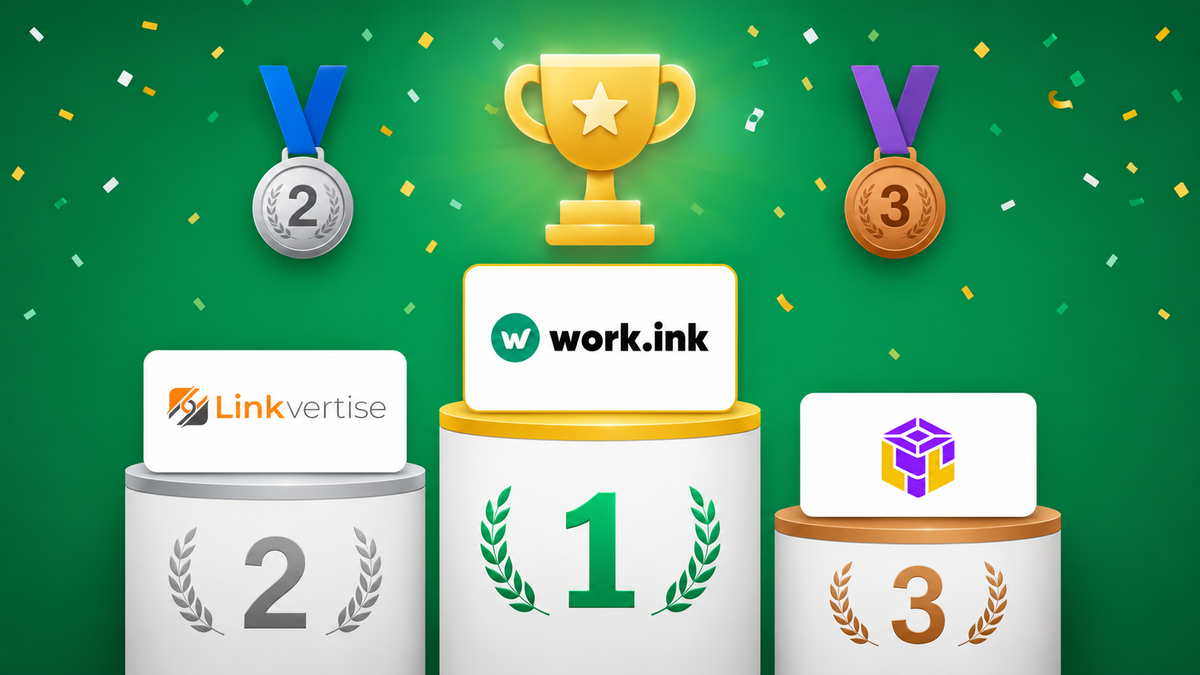
Why Publishers Are Moving to Work.ink in 2026
A look at what actually separates link monetization platforms — and why the differences matter more this year than they did last year.
If you monetize links, you have probably used Linkvertise or Lootlabs at some point. Both are established, both have real publisher bases, and both work. This article is not going to pretend otherwise.
What it will argue is that the criteria publishers use to pick a platform have shifted. Three years ago, the question was simple: who pays the highest CPM? In 2026, that question is still important — but it now sits alongside two others that used to be afterthoughts. What is actually being shown to my audience? And how much of my traffic is quietly disappearing before it ever converts?
Those are the questions this piece is about.
1. What your audience sees is now your problem
Here is the uncomfortable structural reality of link monetization: most platforms plug into open advertising exchanges. Inventory flows in from a wide pool of demand partners, gets filtered against whatever rules the platform has configured, and gets served. The platform is a pipe, and the advertiser mix is largely determined upstream.
That model is efficient. It is also why publishers on open-exchange platforms periodically find things in rotation they did not expect.
Casino and gambling creative is the most common example. It converts extremely well, it pays well, and it is entirely legal to advertise in most markets — which is precisely why it saturates open inventory. Adult and adult-adjacent creative, including promoted creator accounts from subscription platforms, shows up through the same mechanism.
Now consider who is actually on the other end of a link-locked download in this industry. Game mods. Minecraft plugins. This audience skews young — in many verticals, heavily under 18.
A slot machine ad in front of a thirteen-year-old is not primarily a taste problem. It is a business problem, and it lands on you:
- Platform risk. YouTube, Discord, and TikTok all have policies about where you send your audience. Enough reports about what your link showed and you are dealing with a strike, not a support ticket.
- Advertiser relations. The brands you actually want — hardware, peripherals, games, software — do not want their creative sitting next to gambling and adult inventory. Brand-safe demand is the demand that pays sustainably.
- Community trust. This is the one that does not recover. A user who got hit with something inappropriate on your link does not blame the ad network. They blame you.
- Regulatory direction. Age-appropriate design codes in the UK and EU, and comparable frameworks elsewhere, are tightening on exactly this: what minors are shown and who is accountable for it. That trend is not reversing.
Here is where we are going to be more honest than a marketing article usually is: Work.ink runs an open exchange too.
We are not going to claim we solved this by sitting out the open market. We did not. We draw from broad demand, the same way our competitors do, because a restricted demand pool means restricted rates and you are not here to earn less.
The difference is not where inventory comes from. It is what happens between the exchange and your user.
Most platforms filter with static rules — category blocklists, domain lists, advertiser allowlists. That approach fails in a predictable way. Blocklists only catch what someone already thought to add, and the creative that causes problems is precisely the creative that was designed not to look like the thing on the list. A gambling ad dressed as a mobile game. An adult creator account promoted as a generic social link. A category tag that says "entertainment."
We filter with automated classification that evaluates the actual creative — the landing page, the imagery, the copy, the redirect chain behind it — rather than trusting the category label the advertiser attached to it. Rules check what an ad claims to be. Classification checks what it is.
That is a real difference in kind, not a slogan. It is also not perfect, and we are not going to tell you it is. Automated filtering has a nonzero miss rate, and any platform claiming a zero is either not measuring or not telling you. What we will commit to is that the miss rate is low, that flagged creative is pulled network-wide rather than per-publisher, and that publishers have a direct route to report anything that gets through — which is the part that closes the loop and the part most platforms do not staff.
We have also been publicly reducing the network's reliance on install offers, which are the category most consistently associated with poor user outcomes and malware complaints. That decision costs revenue in the short term. We made it anyway, because a monetization platform that burns its publishers' audiences does not have a business in five years.
Note for publishers evaluating platforms: do not take anyone's word for this, including ours. Run a test link through each platform you are considering, from your own audience's primary GEO, and screenshot what comes up. Ad rotation is geo- and user-dependent, so test from where your traffic actually lives. Fifteen minutes of this tells you more than any comparison article.
2. Bypass leakage is the invisible tax on your earnings
Every publisher understands CPM. Far fewer track completion rate, which is the number that actually determines what lands in your account.
Bypass tools — browser extensions, userscripts, dedicated bypass sites, Discord bots — strip the monetization step and hand the destination URL straight to the user. When that happens, you get a click and no conversion. The traffic was real, the user got your content, and you were paid nothing.
The leakage is worse than most publishers assume, for a specific reason: bypass usage is highest exactly where link-locking is most common. The gaming and modding communities that make up the core of this industry are technically literate, well-organized, and share bypass methods openly. A widely-bypassed platform can be losing a substantial share of completions on precisely the traffic it is best at attracting.
We are going to be straightforward about this: no platform is permanently unbypassable, and anyone who claims otherwise is either marketing or has not looked. Link locking is an adversarial problem. Someone will always be working on the next method.
What separates platforms is not whether bypasses get built. It is how fast they die.
Work.ink runs anti-bypass as continuous, staffed enforcement rather than a feature that shipped once:
- Active monitoring of bypass communities, repositories, and distribution channels
- Rapid detection and invalidation of new methods, typically measured in hours
- Server-side validation so completion cannot be faked client-side
- Regularly rotated integrity checks that break automated tooling at scale
- Ongoing takedown work against bypass sites and extensions
The publisher-facing result is that our completion rates hold up under adversarial pressure instead of decaying over time. And this is checkable — completion rate is visible in your dashboard. If you are running elsewhere, pull your click-to-conversion ratio right now. If there is a meaningful gap between traffic delivered and conversions recorded, that gap is your answer.
3. How you earn, not just how much
Every platform in this space claims the highest rates, which is why the claim carries almost no information. We are going to skip it and talk about structure instead, because structure is what you can actually verify before signing up.
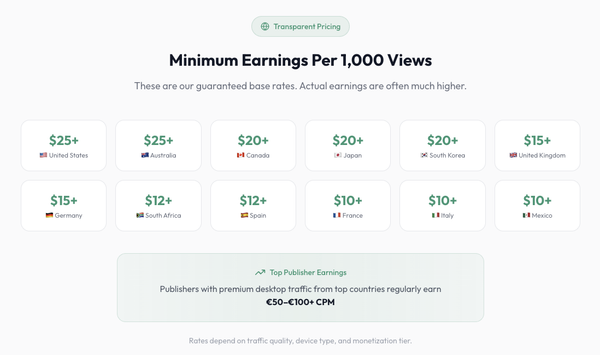
Guaranteed minimums, published by region. Our rates are published as floors, not ceilings. This is a bigger distinction than it looks. "Up to X per 1000 clicks" describes a best case that most publishers will never see — it is a marketing number. A guaranteed minimum describes the worst case, which is the only number you can actually plan a month around. When you compare platforms, check which kind of number you are being shown. Current figures are on our rates page.
The Work.ink SDK. Monetize desktop applications, installers, and tools with a few lines of code. Sponsored offers integrate directly into your software, which opens a revenue stream with no link click involved at all. If you ship software rather than files, this is the part worth looking at.
Direct advertiser relationships. Fewer intermediaries between an advertiser's budget and your payout means more of that budget survives the trip. This is unglamorous and it is where a meaningful share of the difference between platforms actually comes from.
4. Control that belongs to the publisher
Aggressive monetization and audience retention pull against each other. Most platforms resolve that tension for you, in their favor.
We hand you the dial. The Monetization Level setting lets you set exactly how many monetization steps a user completes before reaching your destination — from a single minimal step at the lowest level, up to several stacked steps at the highest.
The tradeoff is the obvious one, and it is yours to make rather than ours. More steps means more revenue per visitor and more friction. Fewer steps means a cleaner run-through and a lower per-visitor take. Turn it up on evergreen content people will wait for. Turn it down on time-sensitive releases where friction costs you the user. You know your audience's tolerance better than any platform does.
Alongside this: a €10 minimum payout, monthly payments, PayPal and bank transfer, and account manager access for publishers scaling volume.
The short version
Linkvertise and Lootlabs are real platforms that pay real money, and if they are working for you, that is a legitimate reason to stay.
But if you are running an audience that skews young, behind a filtering layer you have never inspected, with a completion rate you have never actually measured — you are carrying two costs you probably have not priced. One shows up as a number in your dashboard. The other shows up the day your community stops trusting your links.
Every platform in this industry buys from roughly the same demand pool. The question is not who has the purer supply. It is who is actually checking what reaches your users, and whether they can tell you how well it works.
Work.ink is built for publishers who would rather not carry either.
Earnings vary based on traffic quality, device type, geography, and monetization tier. We encourage publishers to test multiple platforms directly rather than relying on any single comparison — including this one.